Planning

What the tropics ask of a sauna.

A sauna here holds 90°C a few centimeters from tropical air. This page is how we plan for that — humidity, timber, power, and the years after.

Humidity & ventilation

Air that already carries water.

Tropical air is humid all year, and an air-conditioned house holds a second climate inside it. A sauna sits between the two, so ventilation is planned before the first panel is fitted — where fresh air enters, where warm air leaves, and where the cool-down water drains.

Condensation forms wherever heat meets a cooled surface. The answer is never a stronger heater; it is a wall assembly that can dry out — vapor control on the warm side, an air gap behind the paneling, and materials that tolerate the daily cycle.

Timber

Wood that keeps its calm.

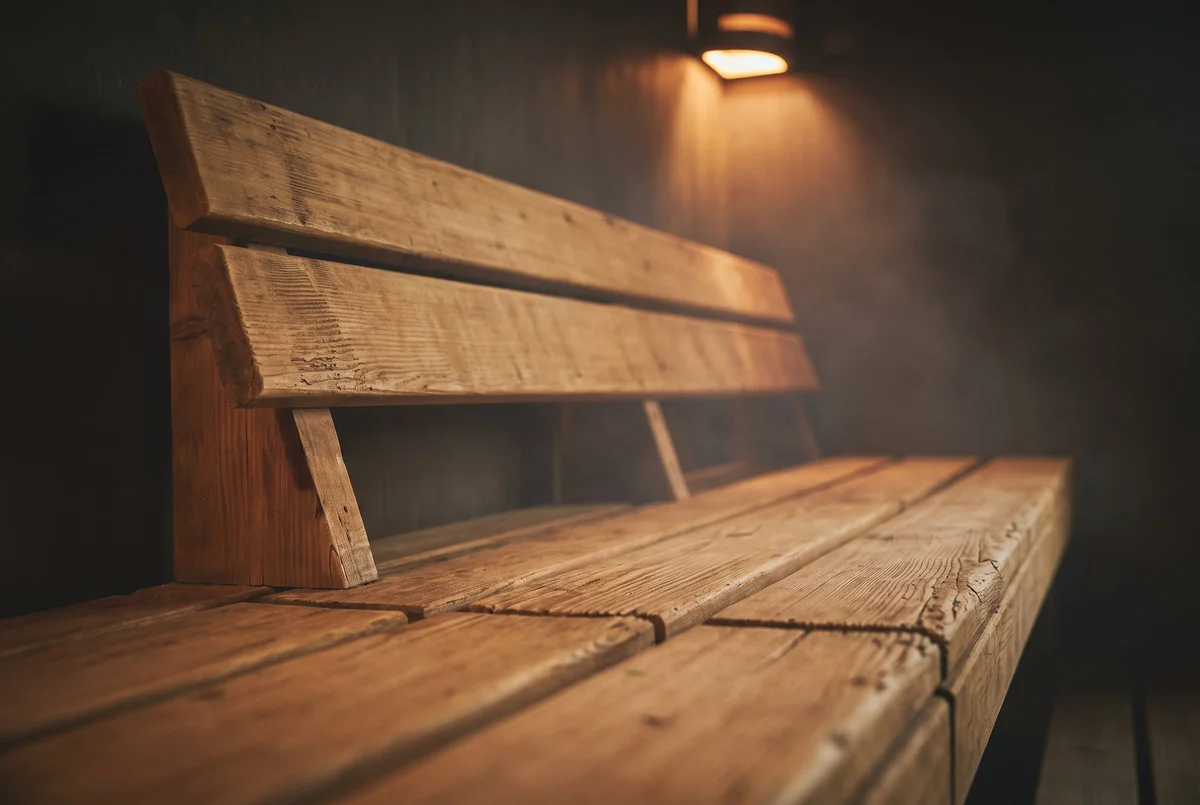
SAWO builds its rooms in cedar, aspen, and hemlock — sauna woods by nature: low in resin, gentle against skin at temperature, and steady as moisture comes and goes.

Thailand works the wood harder — humid air, salt near the coast, sharp drying under air-conditioning — so species choice, fastening, and detailing matter more here than in Finland. Inside the hot room the timber stays essentially bare; nothing is applied that could off-gas at temperature.

Macro of cedar bench slats and backrest, warm sconce glow, shallow depth of field

Power

Electricity, before everything else.

SAWO's heaters run from 2.3 to 24 kW, and the commercial Taurus series reaches 36 kW. Family-size heaters usually ask for a three-phase supply; compact heaters and far-infrared rooms warm from a standard 230-volt socket.

We confirm your site's supply early. Meter capacity, cable runs, and breaker sizing belong in the first design conversation with your electrician — not in the last week of the build.

Aftercare

A room that is serviced, not just sold.

A sauna is a working room. Heater stones settle and want re-stacking, benches can be sanded back to fresh timber, and controls and gaskets have working lives of their own.

We service what we install, from our Pattaya base. Write on WhatsApp, and someone who knows your project answers.

The differentiator

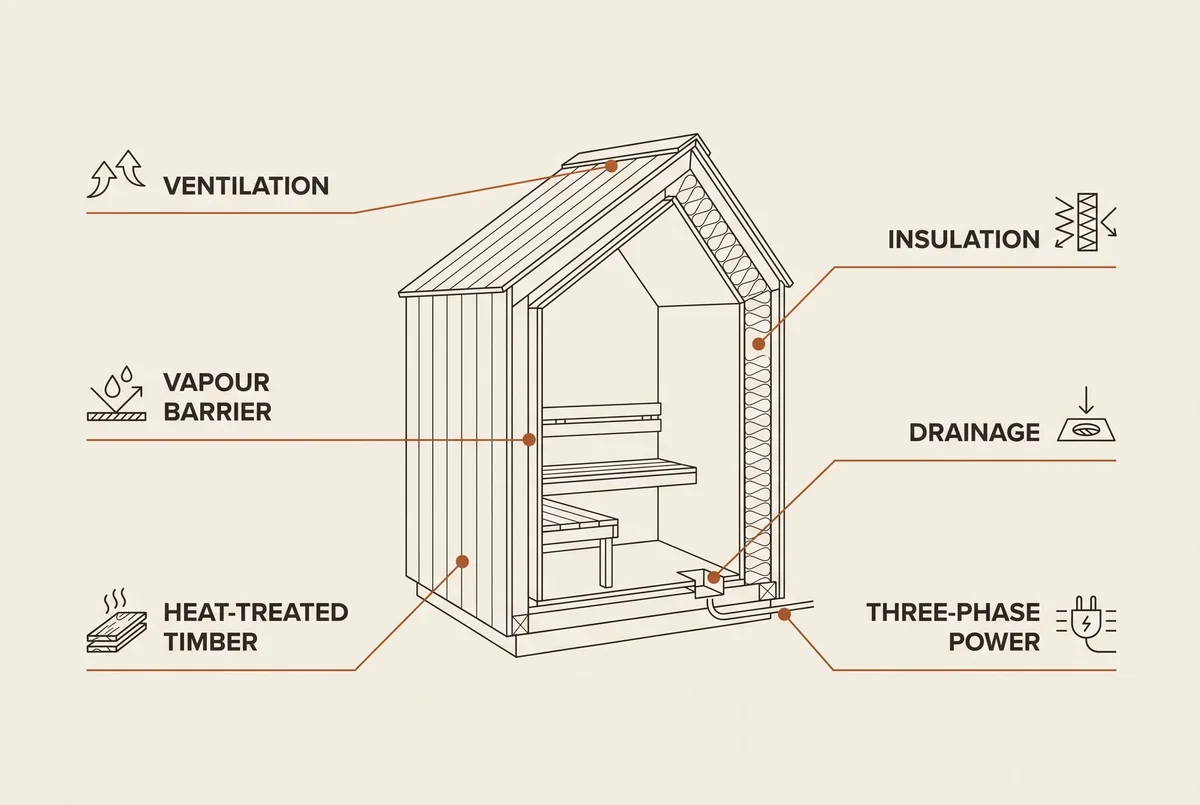
Built for the tropics, in one drawing.

Ventilation, vapor barrier, heat-treated timber, insulation, drainage, three-phase power — the six decisions a tropical installation asks for.

Cutaway diagram of a tropical sauna cabin: ventilation path, vapor barrier, heat-treated timber, insulation, drainage, and three-phase power, each labeled

The timbers, compared

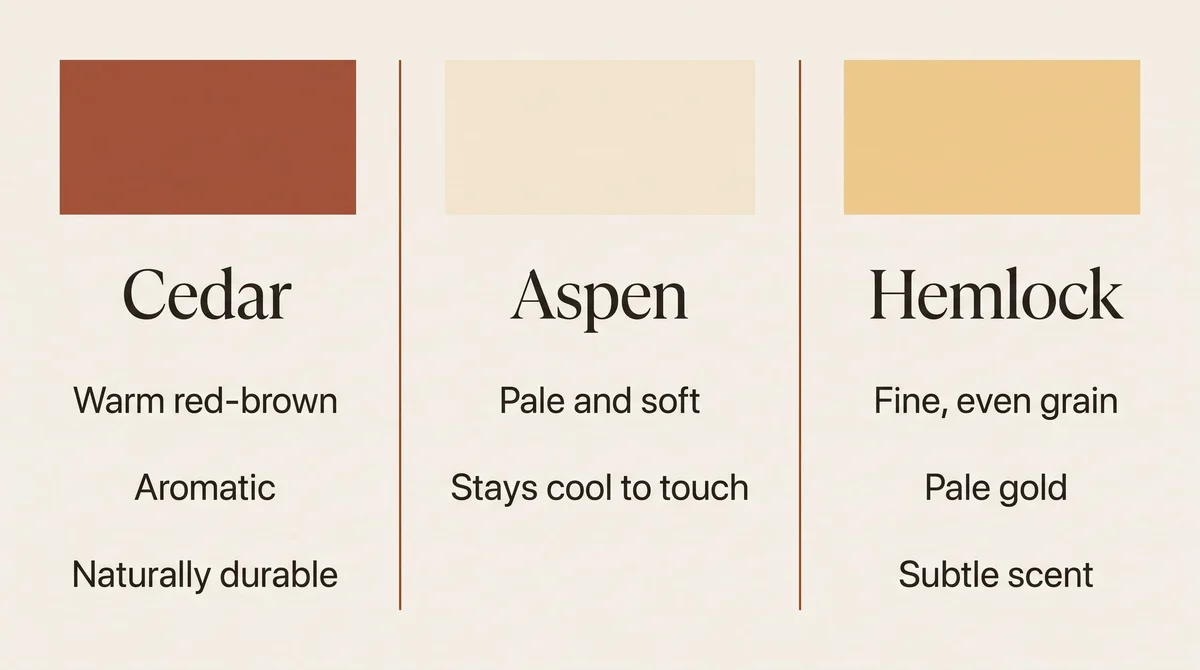
Cedar, aspen, hemlock — side by side.

Look, feel, heat behavior, and tropical suitability for each of SAWO's three room timbers.

Comparison chart of cedar, aspen, and hemlock sauna timbers by look, feel, heat behavior, and tropical suitability

The project process

From first sketch to first löyly.

Löyly — the soft rise of steam when water meets hot stone.

  1. The conversation

    Your site, your habits, your budget's shape — at your site or ours.

  2. The design

    Dimensioned drawings and an equipment specification, prepared with your architect or builder.

  3. The supply

    As the authorized SAWO distributor in Thailand, we supply genuine SAWO equipment backed by SAWO's manufacturer warranty.

  4. The installation

    Our team installs, commissions, and heats the room for the first time.

  5. The first löyly

    You take over a working ritual, not a stack of boxes — and we stay reachable.

The Planning Guide

The tropics, on paper.

Humidity, ventilation, timber, power — everything on this page, condensed for your architect or builder, ready to download.

Questions

Asked before most projects.

Can a Finnish sauna work in Thailand's climate?

Yes. The hot room behaves the same anywhere; what changes in the tropics is everything around it — ventilation, vapor control, timber detailing, and the cool-down. Those are design questions, and they are what this page is about.

What power supply does a sauna need?

Compact heaters and far-infrared rooms run from a standard 230-volt socket; larger heaters ask for a three-phase supply. We confirm your site's capacity during the first consultation.

Which wood should I choose?

SAWO builds rooms in cedar, aspen, and hemlock. Cedar is aromatic and naturally durable; aspen is pale, low in resin, and gentle to the touch; hemlock is even-grained and calm. The right choice depends on your interior and the room's exposure — we advise during design.

Do you work outside Pattaya?

Yes. We design, supply, and install across Thailand — Phuket, Samui, Bangkok, Hua Hin, and beyond — with our Pattaya base keeping service within reach.

Every project begins with a conversation

Book a consultation

A detailed, personal conversation about your project — at your site or ours.

Reach us directly

We reply within one business day.