A heat culture that needs no introduction
Long before a Finnish heater reached Thailand, this country had its own working relationship with heat and herbs. Herbal steaming — op samunphrai (อบสมุนไพร) — is practiced across the country today: a single-person steam cabinet is a tu op samunphrai, and a larger communal steam room is a hong op samunphrai. Walk into almost any traditional Thai spa and you will find one.
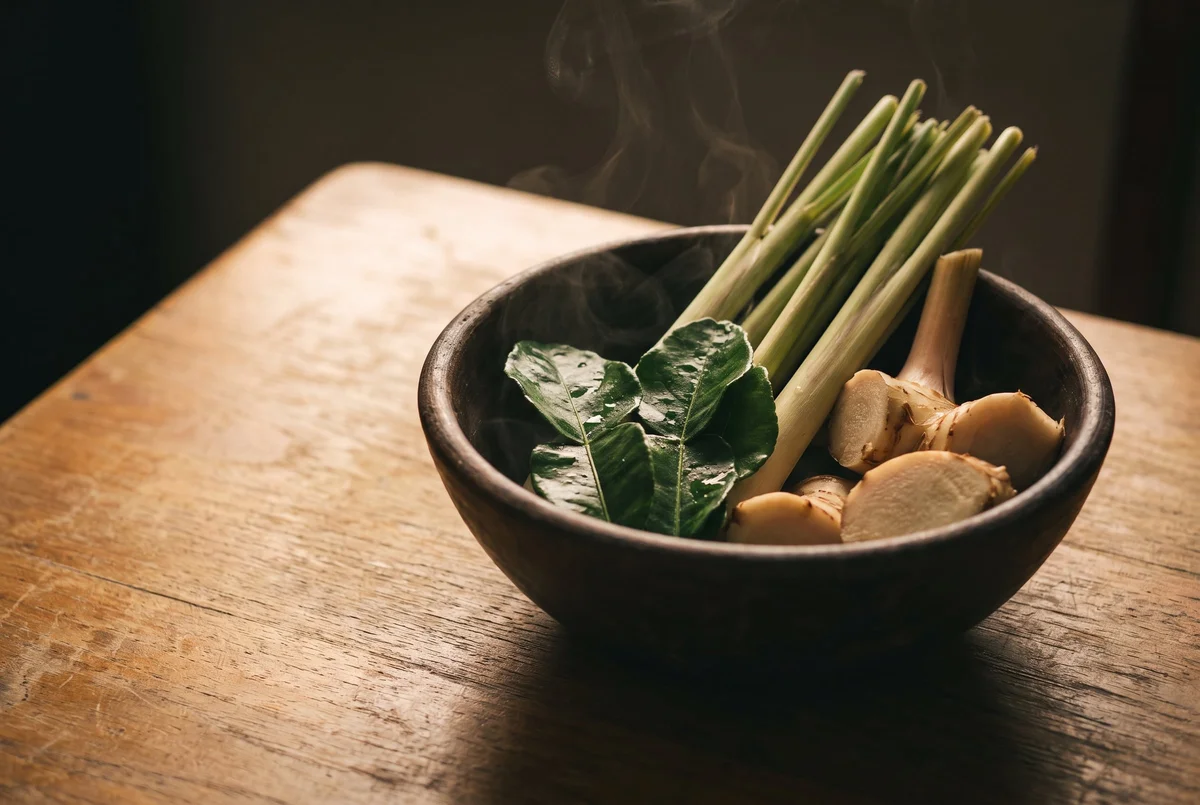
The herbs vary by region and recipe, but the shortlist reads like a Thai kitchen garden: lemongrass, kaffir lime, turmeric, galangal, plai, ginger, camphor, pandanus, tamarind leaf. Thai tradition holds that each contributes something — warmth, fragrance, ease. These are traditional understandings, carried through practice rather than clinical trial, and we describe them exactly that way; we make no medical claim for any of them.
Wat Pho’s place in the story
One account, still told at the temple today, credits King Rama I with an act of preservation: after Ayutthaya fell in 1767 and much of the kingdom’s accumulated medical knowledge was lost with it, he had what remained of Siam’s traditional medicine — herbal treatments among it — inscribed in stone at Wat Pho in Bangkok, where herbal steam and traditional massage are still practiced today. The precise history is carried more as living tradition than settled academic record, and we repeat it in that spirit — not as a footnoted fact, but as the story Thailand tells about its own heat culture, which is testimony enough of how long that culture has mattered here.
The practice sits beside older threads still. Swedana, the steam treatment of Ayurvedic medicine, shares the same instinct of drawing out heat and herb together — a reminder that Thailand’s herbal steam did not develop in isolation from the medical traditions of its neighbors.
Yu fai — heat as recovery, not just ritual
A second Thai tradition puts heat to a specific purpose: yu fai (อยู่ไฟ), literally “lying by the fire,” a centuries-old postpartum practice pairing sustained warmth with herbal steam and hot compresses to support a new mother’s recovery. Urban versions have simplified the original fire-side convalescence, but the steam and the compress remain, still offered today. It is the clearest example in Thai tradition of heat treated not as indulgence but as care — the same instinct, in different clothes, that a Finn reaches for after a hard week.
The same instinct, a different climate
Thailand’s standing as a spa destination is not a marketing invention: the country was named World’s Best Spa Destination at the inaugural World Spa Awards in 2015, and the Thai Spa Association still runs an annual Thailand Spa & Wellbeing Awards with backing from the Tourism Authority of Thailand. “Spa capital of Asia” is language TAT itself uses to promote the country — worth knowing as tourism promotion, not an independent ranking, but it points at something real: heat and herb, offered deliberately as care, is already native here.
Löyly — the soft rise of steam when water meets hot stone — is the Finnish sauna’s own word for the moment its heat culture peaks. It asks for less ceremony than op samunphrai and no herbs at all, but it is recognizably the same instinct: heat, held close, on purpose. We think of what we do less as importing a foreign practice than as adding a second heat tradition beside one that was already here — Wat Pho’s steam room and a sauna room or steam generator from our own collections, sitting in the same house, answering the same old question about what heat is for.
Where the two traditions meet
We don’t sell herbal steam cabinets, and we would not dress up a SAWO sauna as a hong op samunphrai — the honesty of each tradition matters more to us than a tidy marketing bridge. What we do believe is that a country which has organized its own medicine, its own postpartum care, and its spa industry around deliberate heat will recognize almost immediately what a Finnish sauna offers. If Thailand’s own heat heritage is part of why you’re reading this, our planning guide is the practical next page, and a conversation with us costs nothing to start.