The study everyone cites
In 2015, JAMA Internal Medicine published the results of a Finnish cohort called KIHD — the Kuopio Ischaemic Heart Disease Risk Factor Study. Researchers had followed 2,315 middle-aged men from eastern Finland, aged 42 to 60 at the start, for a median of 20.7 years. Their exposure of interest was ordinary: how often the men used a sauna.
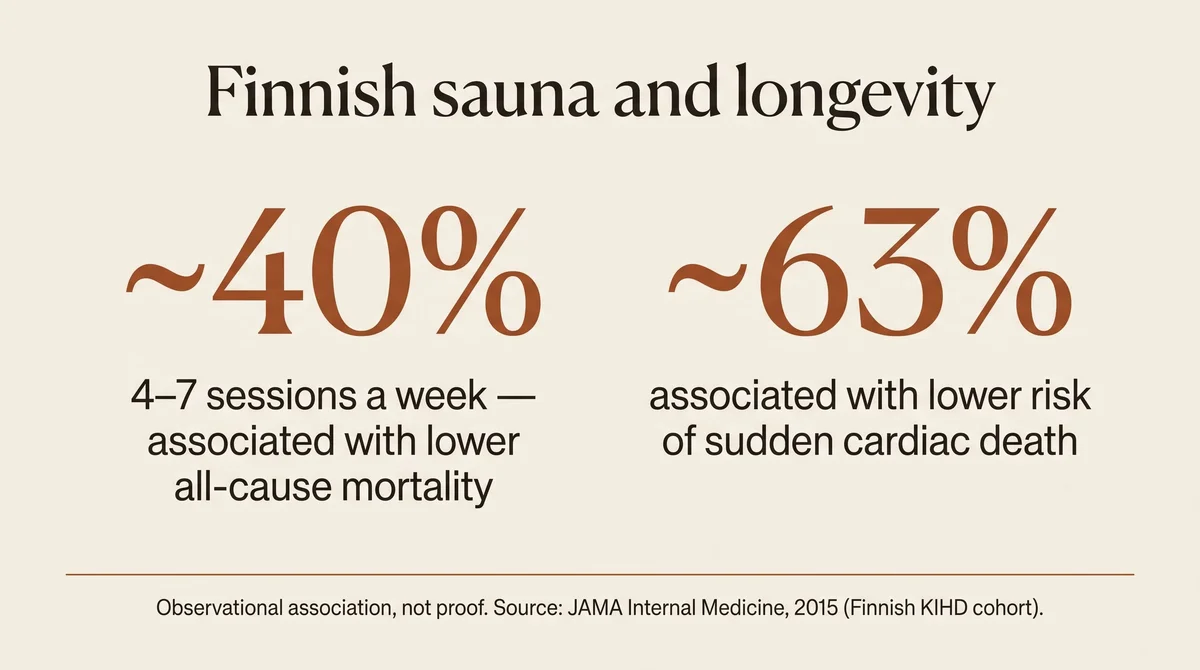
Men who bathed four to seven times a week had a substantially lower rate of sudden cardiac death than men who bathed once a week — an adjusted hazard ratio of 0.37, or roughly 63 percent lower. All-cause mortality was about 40 percent lower across the same comparison. Session length mattered too: men whose sessions ran longer than 19 minutes had roughly half the rate of sudden cardiac death of men whose sessions stayed under 11 minutes. (Duration tracked the cardiac outcomes, not the all-cause figure — a distinction the paper is careful about, and so are we.)
Three years later, the researcher who led that study — Jari Laukkanen — reviewed the wider evidence with a colleague, Setor Kunutsor, in Mayo Clinic Proceedings (2018), gathering findings across cardiovascular and other outcomes. The pattern held across the literature: more frequent sauna bathing kept turning up beside better outcomes, not just in the original cohort.
What “associated with” means, and what it doesn’t
Both papers describe an association, not a controlled experiment. The men in the KIHD cohort were not assigned to sauna use by a coin flip; they reported how often they already went, and researchers watched what happened to them over two decades, adjusting statistically for age, blood pressure, cholesterol, smoking, and other known risk factors. That is a real and useful kind of evidence — much of what we know about diet, exercise, and longevity has been learned this way — but it cannot rule out that healthier men were also, for some other reason, the ones bathing more often.
So we say what the researchers say: frequent sauna bathing is associated with lower cardiovascular and all-cause mortality in this population. We do not say it is proven to extend life, and we would want you to bring the same skepticism to any supplier who tells you otherwise.
It is worth naming what these two papers actually studied, too: traditional Finnish sauna bathing, at high temperature, in dry or lightly steamed air. Infrared cabins were no part of the KIHD cohort or the Mayo review. We sell infrared rooms alongside our traditional lines, and we describe them exactly as SAWO specifies them — gentle radiant warmth from a standard socket — never with the cardiovascular language above, because that language was never tested against infrared heat.
Why this reached an audience outside Finland
Much of the recent attention on sauna and longevity outside Finland traces to Andrew Huberman, the Stanford neuroscientist whose podcast, Huberman Lab, has popularized a rough weekly protocol — roughly an hour total, split across two or three sessions, at temperatures between 80 and 100°C. Huberman did not run the KIHD study; he is a popularizer of it, summarizing the Finnish research for a wide audience and pairing it with his own reading of thermoregulation physiology. That distinction matters to us: we cite JAMA Internal Medicine and Mayo Clinic Proceedings because they are the primary evidence, and we mention Huberman because he is the reason many of our clients first heard the word “sauna” described as more than a spa amenity.
What we take from it
We are not a research institution, and we make no claims of our own beyond what these papers say. What we do take from the evidence is a design principle: if there is any truth to a relationship between frequency, duration, and outcome, a sauna that gets used often is worth more than one that only gets admired. That shapes how we plan a room — reachable from a bedroom or a pool deck, sized so heating it doesn’t feel like an occasion, built for a household’s actual week rather than a single dramatic photograph.
If you are weighing a sauna against the research you’ve read, the honest next step is not a sales call — it’s our planning guide, which covers how a room built for daily use differs from one built for show. When you are ready to talk specifics, every project with us begins with a conversation, not a quote.